I’ve been thinking: Sudoku is nice, but the middle phase where you get interesting deductions is just not long enough. So, to solve that problem, here’s a few infinitely large sudoku variants I came up with. Feel free to implement any of these.
The Staircase: Each row is offset from the next by one cell, allowing for infinitely many rows and columns while each of them contains only nine digits. Regions can be whatever nine adjacent cells you want, like Jigsaw sudoku.
The Fractal: Every cell in an n by n grid contains an n-1 by n-1 grid, and that grid’s digits are the digits in the n by n grid other than the one in the cell. Regions are jigsaw again. Technically that one only has O(n!2) cells, But given that humans can only live for about three hundred million seconds, that’s probably close enough to infinity. You could also make it one-dimensional: instead of an n by n grid, you use a single row of size n.
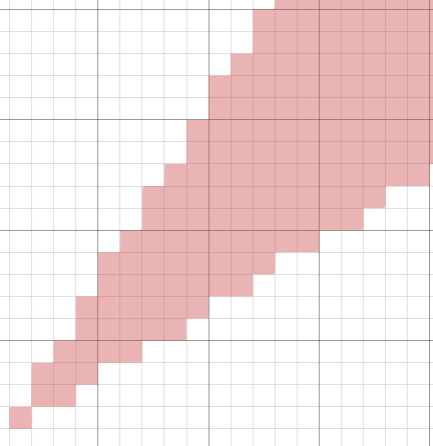
The Cone: Row N contains digits from 1 to N and column N also has digits from 1 to N. Regions are jigsaw (one region of each possible size). In case you don’t understand what shape the grid is, here’s an image of the grid shape recreated in Desmos:
The Hypercube: Each cell has infinitely many coordinates, each of which only has nine possibilities. The 2D slices fixing all but two of the coordinates have to all be normal Sudoku grids.
All of these have downsides: The Staircase only really has two places to make deductions from, The Fractal still sorta has starts and ends, The Fractal (1D) is one-dimensional, The Cone has only 55 cells available before you’re forced to worry about digits other than 1 to 9, and The Hypercube is hard to visualize, and actually has no valid solutions past four dimensions.
Leave a Reply